Europe’s data centre challenge: growth meets physical limits
Europe is witnessing an unprecedented boom in data centre development, fuelled by digitalisation and the rapid rise of AI. Yet operators and investors must also navigate growing challenges around power availability, sustainability and climate resilience. Drawing on their experience from data centre projects across Europe, Drees & Sommer experts Peter Junker, associate partner, and Mathias Franke, head of data centre consulting, discuss the trends shaping the next generation of digital infrastructure.
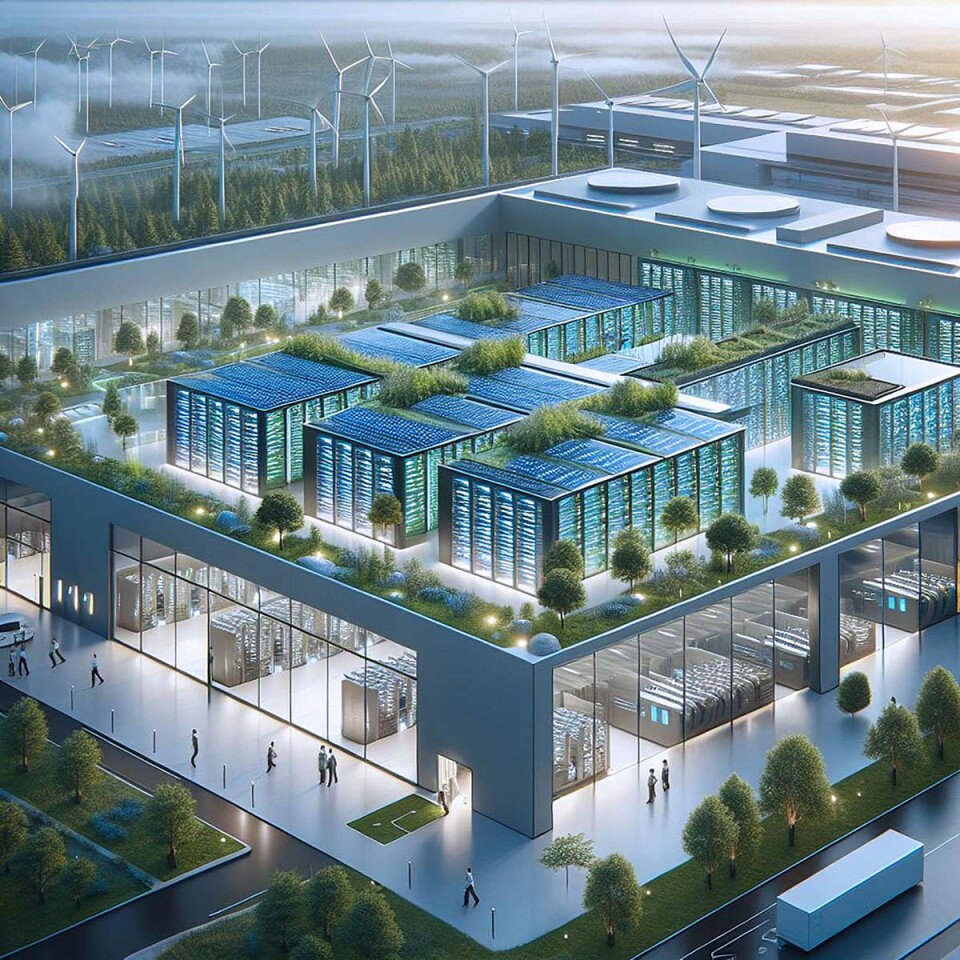
Data centres are increasingly viewed as strategic infrastructure, requiring an integrated approach to energy, resilience and environmental performance. © AI generated
With the European data centre market expanding at exceptional speed, what developments are you currently observing across the sector, and how are they changing priorities for investors, developers and operators?
Peter Junker: What stands out is the sheer pace at which the market is evolving. In Germany alone, installed data centre capacity has more than doubled since 2010, and projections point to further strong growth by the end of the decade. Across Europe, we see significant investment activity both in established hubs such as Frankfurt, London, Amsterdam and Paris, and in emerging locations that can offer access to power and room for future expansion. Grid capacity, project delivery timelines, resilience and long-term sustainability now play a decisive role in investment decisions.
Mathias Franke: Digital growth is beginning to collide with physical constraints. AI is driving demand for more computing power, placing greater pressure on energy supply, cooling capacity and operational resilience. This means that developing and planning data centres today requires a much more integrated approach. Clients are looking for solutions that balance performance, efficiency, environmental responsibility, public acceptance and long-term adaptability from the start.
Can the industry reconcile rapid data centre growth with its sustainability ambitions?
Peter Junker: I believe it must. Digitalisation and sustainability are often presented as opposing goals, because data centres consume significant amounts of energy and resources. In reality, both need to advance together. Data centres are essential for enabling digital business models and AI applications, which provide the foundation for innovations that help companies optimise processes, improve energy efficiency and use resources more effectively. The task is to make sure that the infrastructure behind digital growth becomes progressively more efficient and resource-conscious.
Peter Junker, associate partner
Mathias Franke: Reducing energy consumption is one part of the equation. We also need to optimise the facility across its entire lifecycle. Our clients want to combine sustainability with resilience and operational efficiency. The best projects integrate these priorities rather than addressing each one separately.
How is climate change influencing the way data centrs are planned and operated?
Mathias Franke: Climate resilience has moved much higher up the agenda. Extreme heat was historically treated as a secondary concern by many operators. Today, longer and more frequent heatwaves directly affect how facilities are designed and operated. Meanwhile, AI applications and more powerful chips are generating far greater heat loads within the facility. Operators therefore face pressure from both directions: higher temperatures outside and more heat generated inside. This makes cooling infrastructure critical to operational reliability.
Peter Junker: The industry is shifting from compliance-focused thinking toward resilience-focused thinking. Organisations want facilities that remain efficient, reliable and commercially viable even under more challenging environmental conditions.
Is access to power becoming the industry’s biggest bottleneck?
Peter Junker: In many regions, yes. While demand for data centres continues to grow, power infrastructure is not always expanding at the same pace. For many projects, access to sufficient electrical capacity has become one of the most important site-selection criteria. Interestingly, the issue is not necessarily a lack of available power. Across Germany and the wider EMEA region, many locations offer sufficient grid capacity. However, these locations are often less attractive to operators than established data centre hubs.
Mathias Franke: Power availability is a major challenge, but it must be considered together with resilience and efficiency. A successful facility needs a reliable electricity supply, robust backup systems, operational flexibility and an effective cooling concept. This is driving closer examination of local energy solutions, micro-grids and other approaches that can strengthen resilience while supporting environmental ambitions. In addition, flexible connection agreements (FCAs) are increasingly being considered as a way to enable faster grid connection even in the event of capacity constraints.
What makes for a future-proof data centre location today?
Mathias Franke: A future-proof location is designed with the next twenty years in mind, ensuring reliable operations under changing conditions. Future temperature trends, water availability and exposure to extreme weather events are receiving far greater attention than in the past. Site selection has therefore evolved into a multidisciplinary exercise. The most successful projects consider technical, environmental and operational factors together at an early stage.
FRA27 in Frankfurt, a Digital Realty project supported by Drees & Sommer, illustrates the value of this integrated approach. From power availability and operational resilience to urban integration and long-term scalability, key considerations were evaluated holistically during the planning process.
Peter Junker: From an investor and developer perspective, a good location today is about much more than available land. Alongside power and climate considerations, decision-makers need to assess connectivity, permitting conditions, workforce availability and long-term expansion potential. As a result, we see rising interest in locations beyond the traditional data centre hubs.
Looking ahead, what will characterise the next generation of data centres?
Mathias Franke: The next generation of data centres will need to be more flexible, efficient and resilient. AI will continue to increase computing requirements, which means operators must manage higher power densities while maintaining reliability and sustainability goals. We will likely see broader adoption of advanced cooling technologies, greater integration of energy systems and an increased focus on resilience as a design principle rather than an afterthought.
Peter Junker: I would add that the industry is moving toward a more holistic understanding of infrastructure. The future data centre is not just a building filled with servers. It is part of a larger ecosystem that includes energy networks, digital services, environmental priorities and regional development strategies. The organisations that succeed will be those that understand these interdependencies and think beyond short-term capacity requirements.
Subscribe now and stay informed
Joining the CRE Media Europe mailing list is quick and simple. Just provide your contact details below to be added to our distribution list and start receiving the latest news, magazines and special updates, all free of charge.
Commercial real estate (CRE) Media Europe is a free to access news and information service providing dependable, independent journalism. Our mission is to provide the pan-European real estate market with the latest trends and data points, and provide key analytical coverage to help you make better decisions in your business.
To discuss advertising and commercial partnership opportunities please contact eddie@cremediaeurope.com