Power capacity major bottleneck for UK data centres
According to Savills, the UK data centre market is experiencing a significant squeeze, particularly outside of London, as power capacity becomes a major bottleneck.
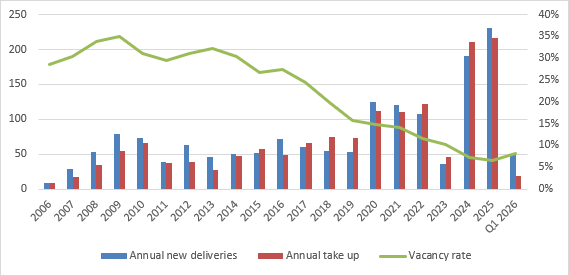
UK data centre demand - Savills
The first quarter of 2026 saw only 19MW of existing data centre capacity taken up, a sharp decline after a record-breaking 2025 (217MW, with 96MW in Q4 alone), indicating a severe lack of available options.
The UK's data centre vacancy rate has plummeted from 27% in 2016 to just 8% in Q1 2026, with London's rate even lower at 7%. This scarcity is most acute in London, which continues to be the primary hub for data centre demand. Occupiers are drawn to the capital's robust cloud ecosystems, dense network infrastructure, and established availability zones, making it the preferred location despite increasing competition for land, power, and faster delivery times. London currently accounts for 91% (1,637MW) of the UK's total live data centre capacity of 1,803MW, a jump from 81% in 2016.
While there's long-term potential for national capacity expansion beyond London, the cloud market in other regions remains relatively underdeveloped. Developers prefer building where connectivity is already established and risks are lower, which primarily means London.
After record deliveries of 191MW in 2024 and 231MW in 2025, the pace has slowed in Q1 2026, with only 48MW delivered. Of the 242MW currently under construction across the UK, only about 66MW is projected to be completed between Q2 and Q4 2026. This highlights the limited immediate supply relative to the overall pipeline and underscores the ongoing challenge of meeting demand, especially in London, due to power limitations and development timelines.
Rupert Duckworth, associate director, Savills Data Centre Advisory, commented: “National supply is expanding on paper, but much of the pipeline remains early-stage and uncertain. Pre-letting has become a core feature of the market, with future capacity increasingly committed well before completion. While activity remains anchored to tier-one locations around London, with Manchester cited as secondary, beyond these two cities, activity is limited, reflecting how difficult it remains to deliver network density, occupier ecosystems and timely access to power.”
Lydia Brissy, director, European Research, Savills, added: “London’s growing share of national capacity heightens exposure to grid scarcity and long connection lead times. Market conversations suggest that, in some of the most constrained West London locations, developers are now planning for multi-year waits for firm capacity, long enough for operators to start to consider alternative power solutions less as a contingency plan than a strategy; using them to bridge the gap to grid capacity and secure position in the right locations.”



Subscribe now and stay informed
Joining the CRE Media Europe mailing list is quick and simple. Just provide your contact details below to be added to our distribution list and start receiving the latest news, magazines and special updates, all free of charge.
Commercial real estate (CRE) Media Europe is a free to access news and information service providing dependable, independent journalism. Our mission is to provide the pan-European real estate market with the latest trends and data points, and provide key analytical coverage to help you make better decisions in your business.
To discuss advertising and commercial partnership opportunities please contact eddie@cremediaeurope.com